
Landlord Registration 2027: Why Managing Rental Properties Is Becoming More Complicated
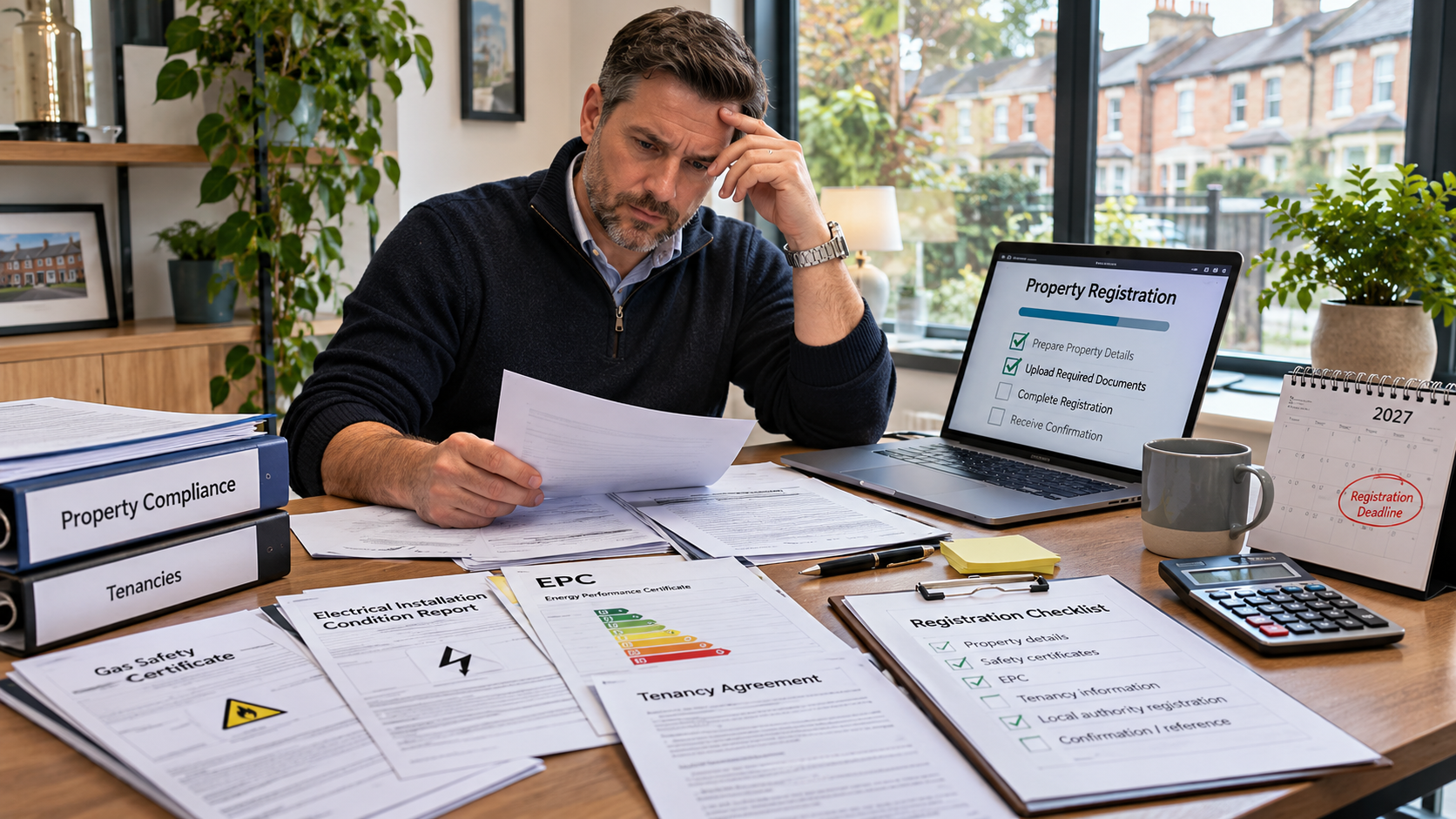
Being a landlord used to sound relatively straightforward. Find a suitable tenant, collect the monthly rent, maintain the property and hopefully watch your investment grow.
But if you’re a landlord in England, you’ll know there’s much more involved.
Between arranging safety inspections, keeping certificates up to date, dealing with repairs, communicating with tenants and understanding changes to legislation, managing a rental property can feel like running a small business.
Now there’s another major responsibility approaching: landlord registration in 2027.
Under the Renters’ Rights Act 2025, private landlords in England are required to register themselves and their qualifying rental properties through the government’s new Register Your Rental Property service.
The system starts rolling out on 15 December 2026, with regional registration deadlines throughout 2027.
For landlords who already struggle to find time for property administration, the new requirements bring additional paperwork, deadlines and ongoing responsibilities.
So, what exactly is changing, what challenges should landlords prepare for, and could professional property management make life easier?
A Typical Landlord’s Week: Work, Tenants, Repairs and Now More Paperwork
Imagine you own two rental properties: a two-bedroom flat in Harrow and a three-bedroom house in Watford.
You work full-time, have a family to look after and manage both properties yourself.
On Monday morning, your tenant in Harrow reports that the boiler isn’t heating properly.
You spend your lunch break trying to arrange a heating engineer.
By Wednesday, the tenant in Watford emails about a leaking bathroom tap.
You call a plumber, arrange access and check whether the repair can be completed before the weekend.
Then, on Thursday evening, you remember that an electrical inspection is approaching.
You start searching through old emails for the latest certificate.
While doing that, you come across information about the new landlord registration requirements.
You discover that you may need to provide property details, safety information, tenancy records and other documents through a government registration service.
Suddenly, you have another task to add to your already demanding schedule.
Neither property is causing a major crisis. Your tenants are generally reliable, and both homes are generating rent.
But keeping everything organised is becoming increasingly difficult.
The challenge isn’t necessarily owning the properties. It’s finding enough time to manage every responsibility that comes with them.
This is an illustrative scenario, but it reflects the practical difficulties landlords can face when managing rental properties alongside work and family commitments.
What Is Landlord Registration 2027?
The new Register Your Rental Property service forms part of the changes introduced under the Renters’ Rights Act 2025.
Its purpose is to create a national record of private landlords and qualifying rented properties in England.
The government intends the system to improve transparency, support enforcement of housing standards and help local authorities identify non-compliance.
For landlords, this means providing information about themselves, their rental properties and relevant tenancy and safety documentation.
The requirement applies initially to privately let properties occupied under assured or regulated tenancies, subject to applicable exemptions.
The registration process is being introduced gradually rather than requiring every landlord in England to register at the same time.
When Does Landlord Registration Begin?
The service opens on 15 December 2026, initially becoming mandatory in the West Midlands.
Different regions then have their own registration periods.
For landlords with properties in London, including Harrow, Pinner, Ruislip, Finchley and surrounding areas, the registration window runs from 15 July to 14 October 2027.
Landlords in the East of England, which includes Hertfordshire, have an earlier registration period, from 15 January to 14 April 2027.
This distinction matters if you own properties in different locations.
For example, someone with a flat in Harrow and a rental house in Watford may have two different regional registration deadlines.
Although landlords can register properties early once the service opens, they must ensure that each property is registered by its applicable deadline.
The Real Challenge: It’s Not Just Another Form to Complete
At first glance, the new registration system might appear to be another online application.
Enter your details, pay the fee and move on.
But landlords need to provide accurate information and ensure relevant records remain up to date.
That means knowing where your documents are, checking whether certificates are current and keeping track of changes throughout the tenancy.
For a landlord with one property, that might seem manageable.
For someone with several properties, different tenants and various contractors, the administrative work can quickly become substantial.
And unlike a one-off form, registration comes with ongoing updating and renewal requirements.
What Documents Will Landlords Need for Registration in 2027?
Preparing the required information is an important part of the process.
According to the government’s registration guidance, landlords will need to provide relevant details covering the property, tenancy and safety arrangements.
1. Property Information
This includes information such as the property’s address, number of bedrooms and current rental status.
Landlords may also need details of managing agents, superior landlords and freeholders, where applicable.
These details must be accurate and reflect the property’s circumstances.
2. Gas Safety Certificates
Where a rental property has a gas supply, landlords must provide relevant gas safety information.
Landlords with applicable gas appliances also need to meet their existing legal responsibilities, including arranging required annual checks.
If you manage multiple properties, each may have a different certificate renewal date.
Forgetting to arrange a check is not simply an administrative inconvenience. It could mean failing to meet an important safety obligation.
3. Electrical Safety Certificates
Landlords must also provide evidence of relevant electrical safety documentation.
For most private rented homes in England, electrical installations must be inspected and tested at least every five years, or sooner where required.
This involves organising a qualified professional, coordinating access with tenants and keeping the resulting report.
Any remedial work must be handled within the applicable legal timescales.
4. Energy Performance Certificates (EPCs)
The registration process also requires relevant EPC information.
Landlords should check that their property has a valid EPC where required and understand the applicable minimum energy efficiency rules.
An EPC is generally valid for ten years, but an expired certificate or changes to the property’s circumstances may require attention.
5. Tenancy and Licensing Details
Landlords will need to provide relevant information about the tenancy, including rent.
If the property requires a House in Multiple Occupation (HMO) licence or another property licence, the appropriate details must also be provided.
Licensing requirements can vary by local authority.
This means a landlord with properties in different boroughs may need to deal with different licensing arrangements alongside the national registration requirements.
The important point is that landlords need more than a list of documents. They need a reliable way of keeping the information accurate and current.
Landlord Registration 2027: Important Deadlines and Costs
The government has published a regional timetable for the registration process.
| Region | Registration begins | Deadline |
| West Midlands | 15 December 2026 | 14 March 2027 |
| East of England | 15 January 2027 | 14 April 2027 |
| East Midlands | 15 February 2027 | 14 May 2027 |
| South East | 15 March 2027 | 14 June 2027 |
| Yorkshire and Humber | 15 April 2027 | 14 July 2027 |
| North West | 15 May 2027 | 14 August 2027 |
| North East | 15 June 2027 | 14 September 2027 |
| London | 15 July 2027 | 14 October 2027 |
| South West | 15 August 2027 | 14 November 2027 |
The annual registration fee is £65 per property, with special pro-rata arrangements during the initial rollout.
For a landlord with five registered properties, that represents £325 in annual registration fees before considering any other property-related expenditure.
The system will also require landlords to maintain accurate records.
Where information changes or expires, it generally needs to be updated within 28 days.
Landlords can submit certain outstanding supporting information within 28 days of registering a property. However, failing to provide the information can result in the registration being deactivated.
These requirements underline why landlords should prepare well before their deadline instead of waiting until the final few days.
For the full details, consult the official government landlord registration guidance.
Property Inspections: Another Responsibility Landlords Must Coordinate
The new registration system does not automatically require every landlord to arrange a new physical property inspection solely to complete registration.
However, it brings greater attention to the documentation associated with existing property safety and maintenance obligations.
And those obligations already require considerable organisation.
Consider what happens when an electrical safety inspection is due.
You need to find a suitable contractor, contact the tenant, arrange access and ensure the inspection is completed.
If the inspection identifies a problem, further work may be required.
You then need to retain the report, manage any remedial action and keep the appropriate records.
Now repeat that process for gas safety, ongoing maintenance, reported damp, plumbing problems and any additional licensing requirements.
For a landlord managing several properties, it’s easy to see how individual tasks become a constant stream of appointments and administration.
The problem isn’t always the cost of the inspection itself.
It’s coordinating everything while ensuring important requirements are not overlooked.
What Happens If a Landlord Misses the Registration Requirements?
Failing to meet the new registration requirements can have serious consequences.
Government guidance states that landlords may face financial penalties of up to £7,000 for failing to comply with the registration requirement.
Higher penalties, potentially reaching £40,000, can apply to certain more serious breaches, including knowingly or recklessly providing false or misleading information or repeated or continuing offences.
These are maximum potential penalties under the relevant circumstances, not automatic fines for every administrative mistake.
Local authorities will have enforcement responsibilities.
For most responsible landlords, the objective should be straightforward: understand the rules, keep accurate information and complete the process within the applicable timescales.
But achieving that consistently requires organisation.
Why Managing Multiple Rental Properties Can Become Overwhelming
Suppose you own three properties.
One is a flat in Harrow, another is a house in Watford, and the third is an HMO elsewhere in London.
Each has different tenants.
Each has different maintenance needs.
Each may have separate gas, electrical and other inspection dates.
The HMO may also require additional licensing arrangements.
The new registration system adds another set of records and deadlines.
You may find yourself keeping track of:
- Rental property registration details and renewal dates.
- Gas and electrical safety records.
- EPC information.
- Applicable property licences.
- Tenancy information and changes in occupancy.
- Maintenance appointments and contractor visits.
- Repairs and remedial works.
- Communications with tenants.
- Rent collection and financial records.
Individually, many of these tasks are manageable.
Collectively, they can create a substantial workload.
This is particularly relevant to landlords who work full-time, live overseas or own properties across different parts of England.
As a property portfolio grows, the time needed to manage it can grow too.
Why Landlords Are Considering Professional Property Management
For some landlords, managing everything personally remains the right choice.
They may have sufficient time, experience and a well-organised system for handling their properties.
Others reach a point where the administrative burden begins to outweigh the money they save by managing things themselves.
Professional property management offers an alternative.
Rather than taking responsibility for every appointment, message and maintenance issue, landlords can appoint a management company to oversee agreed aspects of their rental properties.
This can be particularly valuable when regulatory and operational responsibilities become more complex.
1. Coordinating Property Inspections
A property manager can help arrange inspections, communicate with tenants and coordinate contractors as part of an agreed management service.
This can reduce the number of appointments landlords need to organise personally.
2. Keeping Property Administration Organised
Managing tenancy records, maintenance information and relevant documentation is an important part of property oversight.
A structured management process can help landlords locate important information when it is needed.
3. Managing Repairs and Maintenance
When tenants report a fault, prompt communication and appropriate action matter.
Professional management can help coordinate repairs, arrange contractors and keep landlords informed about the property’s condition.
4. Supporting Ongoing Tenant Communication
Landlords don’t necessarily want to spend evenings dealing with routine enquiries or arranging access for maintenance work.
An appointed property manager can handle agreed day-to-day communication, allowing owners to focus on other commitments.
5. Helping With Registration Information Where Authorised
The government’s new service allows landlords to authorise letting or managing agents to provide certain tenancy and health and safety information after the landlord has started the property registration.
An authorised agent may also help update relevant information.
However, the landlord remains legally responsible for starting the registration, paying the fee and ensuring the required information is submitted.
Whether a management company offers registration assistance should be confirmed as part of its service agreement.
Can a Property Management Company Register a Rental Property for You?
This is an important question.
Under the new rules, landlords generally must start the property registration themselves.
They are responsible for registering the relevant properties, paying the required fees and ensuring the information is complete.
Once a landlord has started registration and obtained the property registration number, they may authorise a letting or property management company to provide certain additional information.
This can include tenancy and relevant health and safety details.
The agent can also be permitted to update applicable information later.
However, appointing a management company does not transfer the landlord’s underlying legal responsibilities.
For landlords, the practical benefit is having professional support with agreed administrative tasks while remaining informed about the property’s requirements.
How BigRoof Can Help Simplify Property Management
At BigRoof, we understand that owning a rental property comes with responsibilities that extend well beyond finding tenants and collecting rent.
Between maintenance, inspections, communication and everyday administration, property management can require a considerable amount of time.
Our property management services are designed to help landlords manage these responsibilities more effectively.
Fully Managed Property Management
BigRoof’s Fully Managed service offers support with tenant finding, rent collection, property management and maintenance.
Our published management offering also includes regular property inspections and ongoing tenancy administration.
This may be particularly useful if you:
- Own multiple rental properties.
- Have limited time to manage tenants and repairs.
- Live away from your investment property.
- Need help coordinating routine maintenance and inspections.
- Want a more structured approach to property management.
- Prefer to reduce your day-to-day involvement.
Our Fully Managed service starts from 6% of rental income, depending on the property and agreed management terms.
While landlords retain their legal responsibilities, professional management can reduce the practical workload involved in looking after their investments.
Any specific assistance with the new registration service should be discussed and agreed separately before relying on it.
Is Professional Property Management Worth Considering in 2027?
The new registration requirements may encourage landlords to reconsider how they manage their properties.
But the decision shouldn’t be based on registration alone.
Ask yourself:
Do I have time to keep track of every certificate, inspection and renewal date?
Can I arrange maintenance appointments without disrupting my working day?
Are my property documents organised and easy to access?
Do I understand which requirements apply to each of my rental properties?
Would professional support reduce the time I spend on property administration?
If managing your rental property increasingly feels like another full-time responsibility, professional management may be worth considering.
The right arrangement depends on the number of properties you own, your experience, your budget and how much involvement you want to retain.
Frequently Asked Questions About Landlord Registration 2027
Is landlord registration compulsory in England in 2027?
Yes, qualifying private landlords must register themselves and their relevant rental properties through the new government service. The requirement is introduced regionally, with different deadlines throughout 2027. Certain tenancy types and accommodation arrangements may be exempt.
When do London landlords need to register?
The London registration period begins on 15 July 2027, with a deadline of 14 October 2027. Landlords can register earlier once the national service opens on 15 December 2026.
How much does landlord registration cost?
The annual fee is £65 per property, with pro-rata arrangements during the initial rollout. The fee is separate from other costs associated with managing and maintaining rental properties.
What documents are required for landlord registration?
Landlords will need relevant property and tenancy details, together with applicable gas safety, electrical safety, EPC and licensing information. The exact documentation required depends on the property and its circumstances.
Will landlords need additional property inspections?
Registration does not automatically create a new universal physical inspection requirement. However, landlords must continue meeting existing safety, maintenance and licensing obligations and provide relevant information as part of registration.
Can a letting agent complete the registration for me?
A landlord generally needs to start registration and pay the fee. An authorised letting or managing agent may then provide certain supporting information and updates. The landlord remains legally responsible for compliance.
Can BigRoof help me manage my rental property?
Yes. BigRoof offers property management services that include tenant finding, rent collection, maintenance coordination and property inspections. If you need specific help preparing for the new registration requirements, contact BigRoof to discuss what assistance can be provided under an agreed service arrangement.
Landlord Registration 2027: Preparation Is Better Than Last-Minute Panic
The introduction of landlord registration represents another change in how private rental properties are managed in England.
For landlords who already keep organised records and stay on top of their responsibilities, the registration process may be relatively straightforward.
For those balancing several properties, full-time work and family commitments, it may highlight just how much administration comes with property ownership.
The key is to prepare early.
Check your documents, understand your regional deadline, review your property’s safety information and decide how you want to manage the ongoing responsibilities.
And if maintaining your rental properties is taking more time than expected, consider whether professional property management could help.
Owning rental property should be about making informed investment decisions, not spending every spare evening chasing paperwork and organising repairs.
Let BigRoof Take the Pressure Out of Property Management
With changing requirements, regular maintenance and ongoing tenant responsibilities, managing rental properties can become increasingly demanding.
At BigRoof, we help landlords simplify the day-to-day management of their investments through professional lettings and property management services.
Whether you own one rental property or several, our team can discuss how our services could help reduce your workload.
Spend less time managing property problems and more time focusing on what matters to you.
Contact BigRoof today to discuss your rental property and explore our Fully Managed service.
Telephone: +44 74 5891 2029
Email: support@bigroof.co.uk
